
The Gods’ Stronghold: How Asgard Functions as a Political Center in…
Asgard is more than the home of the Aesir: in Norse myth, it can be read as a center of divine authority, social order, and conflict within Norse cosmology.

Asgard as a Seat of Divine Authority
In Norse mythology, Asgard is the dwelling place of the Aesir. The source material also presents it as an important focal point in the mythological world, making it useful for understanding how power is imagined in Norse cosmology.
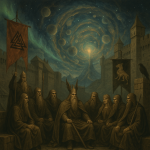
Rather than presenting the gods only as isolated figures, these accounts place them within a shared stronghold. That setting suggests defense, hierarchy, and collective identity. In that sense, Asgard can be read as a mythic center of governance: a place where the Aesir are imagined as a ruling community.
Political Meaning in Norse Cosmology
Asgard’s significance extends beyond residence. The source pack describes it as a focal point in mythological tales that shape the Norse worldview. In broad interpretive terms, this suggests a setting where divine rivalries, relationships, and authority are concentrated within the wider cosmos.
This function is tied to Norse cosmology itself. The Nine Realms are presented in the source pack as a structured universe inhabited by gods, giants, elves, and humans. Within that larger order, Asgard stands out as the realm associated with the Aesir.
The Aesir as a Ruling Community
Asgard is the home of the Aesir, and that detail is central to its political meaning. The Aesir are portrayed as a divine community rather than only as separate powerful beings. Asgard gives that community a center.
In interpretive terms, a shared seat of power suggests coordination and social order. This is one reason Asgard matters in Norse myth: it provides a setting in which divine authority appears collective as well as supernatural.
Authority, Rank, and Divine Order
The idea of Asgard as a political center also highlights rank. A stronghold is organized space, and organization implies hierarchy. Asgard is presented as a realm of the gods, linking authority and status to the Aesir within the mythic order.
For readers of Norse mythology, this is a useful interpretive point. Asgard is not just where the gods live; it also symbolizes concentrated divine power and order.
Conflict and the Politics of the Divine Realm
Asgard is also associated in the source material with power and conflict. That combination supports reading it as an important center within mythic narratives.
In Norse myth, conflict around Asgard underscores its importance. A realm marked by rivalry and threat is presented as a place of consequence within the mythic imagination.
This helps explain why Asgard is often associated with strength and defense in the source pack. The imagery of fortification reinforces the idea that the Aesir’s authority is guarded and contested.
Alliances, Social Bonds, and Mythic Governance
Asgard is not only about rule. It is also about relationships among the gods. The source material presents Asgard as a focal point in stories about the gods, suggesting a social world shaped by bonds and shared action.
That makes Asgard a useful lens for reading Norse divine society. The realm gathers the Aesir into one political and social space, where bonds can be affirmed and tensions can emerge. In this sense, Asgard functions as a mythic court or stronghold of governance, even if that language is interpretive rather than explicit in the sources.
For modern readers interested in Norse religion and worldview, this shows that the gods are imagined within a social order. Their realm is structured, relational, and politically meaningful as an interpretation of the myths.
Asgard and the Wider Nine Realms
Asgard’s role becomes clearer when placed within the Nine Realms. The source pack presents the Nine Realms as central to Norse cosmology, with different worlds inhabited by different beings. Within that system, Asgard is the realm of the gods.
Because the Nine Realms include multiple kinds of beings and domains, Asgard’s place is defined in relation to others. It is not the whole cosmos, but it is presented as a central point within it.
This is why Asgard matters in discussions of Norse cosmology. It is not merely one realm among many; it is a realm strongly associated with divine rule in the mythic universe.
Why Asgard Matters for Norse Myth and Culture
Asgard’s interpretive political function gives it lasting importance in the study of Norse mythology and culture. It is a symbol of power, and it can also be read as a symbol of the organization of power.
For scholars and students, this means Asgard can be read not only as a mythic location but also as a political idea. It represents divine authority among the Aesir, the social cohesion of the gods, and tensions around rule and legitimacy as they appear in mythic storytelling.
For modern readers and mythology enthusiasts, Asgard also remains a potent symbol of divine order and sacred community.
Conclusion
Asgard functions in Norse myth as a center of the Aesir’s authority, a setting for divine social order, and a stronghold associated with conflict. The source material presents it as more than a residence: it is a focal point of the mythological world within Norse cosmology.
Seen this way, Asgard is not simply where the gods are. It is where divine rule is imagined most clearly and where the Aesir are gathered as a community within the mythic universe.