
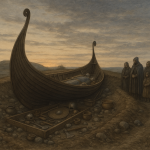
Ship Burials in the Norse World: Elite Graves and Symbolic Passage
Ship burials are among the most striking burial customs associated with the Norse world. They combine elite display, maritime identity, and ideas about the dead’s passage beyond...

Ship Burials in the Norse World
Ship burials occupy a special place in the study of Ancient Norse burial customs. They are among the most visually powerful funerary practices associated with the Viking Age, and they continue to shape modern ideas about Norse religion and society. A ship placed in a grave, or a grave built in a ship-like form, was not only a container for the dead. It could also express rank, identity, memory, and the journey associated with death.
Within the site topic of Ancient Norse mythology, history, culture, and language, ship burials matter because they sit at the intersection of archaeology and belief. They show how Norse communities could express social hierarchy through funerary display while also drawing on a symbolic language of travel, passage, and the afterlife. In later interpretation, these burials are often discussed alongside Valhalla and Hel, even though the relationship between grave practice and mythic afterlife is not always direct or simple.
What Is a Ship Burial?
In broad terms, a ship burial is a burial in which a ship forms part of the funerary arrangement. The ship may contain the body or bodies of the dead, or it may be represented in a more symbolic way. In the Norse world, ship burials are especially associated with high-status individuals and with the display of wealth and authority. They are often treated as elite graves because they required planning, labor, and access to resources.
Source material on Norse funerary practice notes that ship burial is a recognized form of Norse funeral custom, and modern discussion frequently emphasizes its connection to status and social power. One historical summary of recent archaeological interpretation states that the construction of ship graves required extensive planning and labor, and that one purpose was to highlight the authority and wealth of the deceased person’s clan [1]. That point is important: the ship burial was not only about the dead person, but also about the living community that staged the burial.
Why a Ship?
The ship was one of the most meaningful objects in Norse life. It represented movement, trade, raiding, travel, and connection across seas and coasts. In a society shaped by waterways, the ship was not merely a vehicle; it was a cultural symbol. To place the dead in a ship was to place them within a form that already carried strong associations with mobility, power, and transition.
This symbolism works on several levels. First, the ship could mark the deceased as someone of importance, since ships were costly and labor-intensive. Second, it could evoke the idea of a final voyage. Third, it could connect the dead to a wider symbolic imagination in which passage from one realm to another was meaningful. For audiences interested in Old Norse religion, the ship burial is therefore best understood as both social performance and symbolic language.
Elite Status and Funerary Display
Ship burials are often discussed as elite funerary rituals. The archaeological and historical evidence in the source pack suggests that they were rare and reserved for people of high standing. A ship grave could signal authority or the prestige of a powerful family. The burial itself became a public act of remembrance and display.
This emphasis on display is central to understanding the custom. The labor involved in preparing a ship burial would have been visible to the community. The grave goods, the scale of the burial, and the ship form itself all communicated rank. In this sense, ship burial belongs to the broader Norse pattern in which burial customs could express social order as much as religious belief.
Modern summaries of Viking burial practice also note that ship burials were rare and elite rituals for high-status individuals, designed to signify wealth and status [2]. Even when the exact details of a particular burial are uncertain, the general pattern is clear: the ship burial was a conspicuous funerary form, not an ordinary one.
Seafaring Identity in Norse Culture
Ship burials also reflect the deep maritime character of Norse culture. The Norse world was shaped by sailing routes, coastal settlement, and long-distance movement. Ships were central to trade, warfare, migration, and communication. A ship burial therefore did more than honor the dead; it expressed a way of life.
For this reason, ship burials can be read as cultural statements about identity. They suggest that the deceased belonged to a world in which the sea mattered profoundly. The ship became a fitting emblem for a people whose history and daily life were tied to navigation and travel. In some cases, scholars have interpreted boat-graves as linking the deceased and survivors to a Scandinavian homeland, especially in frontier contexts [3].
Ship Burials and the Afterlife
One reason ship burials remain so compelling is that they invite comparison with Norse ideas about the afterlife. Later mythological texts describe multiple possible destinations for the dead. Valhalla is the best-known, but it is not the only one. Other source-pack summaries also mention Fólkvangr and Hel as important destinations in later Norse tradition [4].
It is important to be careful here. Archaeological ship burials do not automatically prove a single, fixed belief about the afterlife. Norse funerary practice was varied, and the relationship between burial form and afterlife destination is not always explicit. Still, the ship burial clearly fits a symbolic world in which death could be imagined as a passage. The ship, after all, is a vehicle of crossing. In mythic and poetic terms, it is easy to see why later readers connect it with the journey beyond the grave.
Valhalla, Hel, and Burial Symbolism
In popular retellings, ship burials are often linked especially with Valhalla, the hall associated with Odin and some of the battle-dead. That association is understandable, but it should not be oversimplified. The source pack emphasizes that Valhalla was not the only destination imagined in Norse tradition [4]. Hel also appears as a realm associated with many who died outside battle, though descriptions vary [4].
For this reason, ship burial should be read less as a literal ticket to one specific hall and more as a funerary symbol that could resonate with multiple ideas about the dead. A ship could suggest the journey of the dead, movement into another realm, or social transformation into an ancestor or honored figure. In that sense, the burial form is flexible enough to fit several Norse afterlife concepts.
Some modern discussions of Norse burial and afterlife stress this range of possibilities directly, naming Valhöll for some, Fólkvangr for others, Hel for many, and the mound for more than we might expect [5].
Archaeology and Interpretation
Archaeological ship burials are valuable because they preserve material evidence of funerary practice. They show how the Norse world used objects, space, and symbolism to shape memory. Yet interpretation must remain cautious. A burial is not a direct transcript of belief. It is a ritual act, and ritual acts can communicate status, kinship, piety, and social ambition all at once.
Recent commentary on ship graves has emphasized the amount of labor involved and the social meaning of that labor. According to one archaeological summary, ship grave construction required extensive planning and labor, and elite families used it to display authority and wealth [1]. That observation helps explain why ship burials are so often associated with power. The burial itself was a public performance of rank.
At the same time, boat-grave research has also explored identity in more nuanced ways. In frontier settings, ship burials may have helped migrants or their descendants maintain links to Scandinavian origins [3].
Ship Burial in the Broader Norse Funerary Landscape
Ship burials were only one part of Norse funeral practice. The source pack also points to the wider range of Norse funerary customs and afterlife ideas, including grave goods and varied destinations for the dead [4]. That broader context matters because it reminds us that Norse burial customs were not uniform. Different regions, periods, and social groups could use different forms of burial and different symbolic emphases.
Within that larger landscape, ship burial stands out because it is so visually and culturally distinctive. It combines the material reality of the ship with the symbolic reality of passage. It also aligns with the Norse tendency to embed social meaning in funerary practice. The dead were not simply buried; they were placed within a carefully constructed statement about who they had been and how they should be remembered.
Reading Ship Burials in Old Norse Terms
For students of Old Norse language and literature, ship burials are especially interesting because they sit near the boundary between material culture and textual tradition. The ship burial is an archaeological form, but it is often interpreted through the lens of saga literature and later mythological writing. Terms such as Valhöll, Hel, and Fólkvangr belong to that textual world, while the ship grave belongs to the archaeological one.
Bringing these together can be fruitful, as long as the limits are respected. The burial custom itself does not prove a single mythological reading, but it does show that Norse people used powerful symbols that later texts may help illuminate. The ship, in particular, is a symbol that bridges the practical and the mythic. It is both a real vessel and an image of transition.
Conclusion
Ship burials in the Norse world were more than dramatic graves. They were elite funerary performances, expressions of seafaring identity, and powerful symbols of passage beyond death. Archaeological evidence shows that they required labor, resources, and social coordination. Historical interpretation shows that they were used to display authority and wealth. Mythic and literary comparison helps explain why the ship could also evoke the journey to Valhalla, Hel, or another destination in later Norse afterlife tradition.
For anyone studying Ancient Norse mythology, history, culture, or language, ship burials offer a compact but rich example of how the Norse world joined social rank, maritime life, and funerary symbolism. They remind us that burial customs were never only about the dead. They were also about the living, and about the stories a community told about power, memory, and the road beyond the grave.
References
- History.com, “Why Did the Vikings Bury Dead in Ships?”
- Facebook source pack item on Viking age burials and the symbolic meaning of boat-shaped graves
- Erin-Lee Halstad McGuire, “Sailing Home: Boat-graves, migrant identities and funerary practices on the Viking Frontier”
- Honor You, “Viking Burials | How Norse Funeral Rituals Worked”
- Northern Black, “Viking Burials and The Afterlife in Norse Mythology”