From Ymir to the Æsir: A Genealogy of Creation and Divine Descent
In Old Norse creation myth, genealogy is not a side detail: it is the architecture of the cosmos. From Ymir’s body to Búri, Borr, and the first generation of gods, kinship...

From Chaos to Kinship in Norse Cosmogony
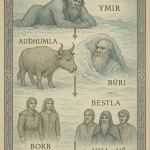
In the Old Norse sources, creation is not only an event but a lineage. The cosmos emerges through bodies, births, and inherited relations. Ymir, the primordial giant, belongs to the earliest phase of existence; Búri, uncovered from ice by Auðhumla, becomes the first god; and from Búri comes Borr, whose union with the giantess Bestla produces Odin, Vili, and Vé. In this way, the divine order is presented as a family tree as much as a cosmological sequence.
This genealogy matters because it links the Æsir to the raw materials of creation while also distinguishing them from the giants. The result is a mythic structure in which kinship, conflict, and sovereignty are inseparable. The gods do not simply appear over against chaos; they arise from it and transform it.
Ymir: The Primordial Ancestor of the Giants
At the beginning stands Ymir, the first giant in the creation tradition preserved in later Old Norse prose sources. Ymir is not a king or a god in the ordinary sense. He is a primal being whose body becomes the substance of the world after his death. The sources describe the gods shaping the cosmos from his remains: his flesh becomes earth, his bones mountains, his skull the sky, and his eyebrows a protective boundary for the world of humans. [1]
Ymir also generates life from within his own body. One source preserves the image of frost ogres emerging from his sweat, including a man and a woman under his arm and a son from his legs. [2] This makes Ymir both ancestor and material: he is a progenitor of giant-kind and the substance from which the ordered world is later built.
For genealogy, this is crucial. The giant line begins before the gods’ line is fully established. The divine family tree therefore starts in a world where kinship is already active.
Auðhumla and the Uncovering of Búri
Alongside Ymir appears Auðhumla, the primordial cow. She nourishes Ymir with her milk while licking salty ice from the frozen world. As she licks, the first god is revealed from the ice: Búri, presented in the sources as an early ancestor of the gods. [3] [4]
The image is important because Búri is not born in the ordinary human sense. He is uncovered, brought into visibility through Auðhumla’s action. This makes his origin different from Ymir’s bodily generation.
In genealogical terms, Búri is the first clear ancestor of the Æsir. His appearance marks the beginning of a distinct divine descent, even though that descent remains tied to the same primordial world from which Ymir comes.
Borr and Bestla: The Meeting of Divine and Giant Lineage
Búri has a son named Borr. The sources are brief on Borr, but his role is central: he bridges the first god and the next generation. Borr marries Bestla, a giantess and daughter of Bölþorn. Their children are Odin, Vili, and Vé. [3] [2]
This marriage is one of the most important genealogical moments in Norse myth. It joins divine and giant ancestry in a single household. Odin and his brothers are therefore descended from both sides. One source in the pack also states that Odin’s parents are Borr and Bestla. [5]
The Æsir are related to the giants by blood, yet they become their opponents in the mythic order. This is one reason the creation genealogy is so powerful: it explains how the gods can be both kin to and enemies of the giant world.
Odin, Vili, and Vé: The First Divine Brothers
From Borr and Bestla come Odin, Vili, and Vé. These brothers represent the first active generation of the Æsir in the creation narrative. In the creation tradition, they kill Ymir and use his remains to shape the cosmos. [1]
Odin is the most prominent of the three in later tradition, but the genealogy preserves the shared brotherhood. The family structure helps frame the emergence of divine authority in the mythic narrative.
The brothers’ action completes the transition from primordial body to ordered world. Ymir’s body becomes the material of creation; the sons of Borr and Bestla become the agents of ordering.
How the Genealogy Structures the Cosmos
The Norse creation genealogy does more than list ancestors. It organizes the relationship between categories of being. Ymir stands for primordial giant life. Búri stands for the first divine emergence. Borr and Bestla unite the two lines. Odin, Vili, and Vé then establish the world from the body of their giant forebear. [2] [3]
This structure gives the myth a distinctive logic. The gods are genealogically embedded in the world they govern. The world is made from ancestral matter, and divine authority is presented through kinship.
Ymir, the Æsir, and the Boundary Between Giant and God
Because the Æsir descend through Bestla, the line between god and giant is not absolute in this genealogy. The gods are related to the giant world even as they define themselves against it. This is visible in the creation myth itself, where the gods use Ymir’s body to build the world and establish boundaries within it, including the fence made from his eyebrows. [1]
The genealogy mirrors this process. Ymir belongs to the pre-order world; Búri begins the divine line; Borr and Bestla unite the two lines; Odin and his brothers create the ordered realm.
Why This Genealogy Matters in Old Norse Studies
The Ymir-to-Æsir genealogy is foundational for understanding Norse mythic thought. It shows that creation, descent, and sovereignty are intertwined. It also demonstrates that Old Norse sources often explain the world through family relations rather than through abstract principles.
For readers, it provides a framework for remembering the sequence from Ymir to Búri, Borr, and the first gods. It highlights the kinship between the Æsir and the older powers of the cosmos.
Most importantly, it shows that in Norse myth, creation is presented not only as an act of making, but also as a line of descent.
References
- Colgate Research, “Norse Creation: Murder on Ice” — used for Ymir’s body becoming the world and the use of his eyebrows as a boundary.
- The Norse Creation Myth — used for Ymir’s sweat-born offspring, Auðhumla, Búri, Borr, and Bestla.
- Norse Mythology for Smart People, “The Creation of the Cosmos” — used for Auðhumla uncovering Búri and the Búri-Borr-Bestla sequence.
- MythologySource, “Norse Creation Myth: A Complete Guide” — used for Auðhumla, Búri, and Borr in the creation sequence.
- GenealogyBank, “Norse Mythology Family Tree” — used for Odin’s parentage.