Thing Assemblies and the Norse Legal Order
The Norse þing was more than a court. It was a public assembly where free men gathered to settle disputes, hear law, take oaths, and shape community order. This article examines how thing assemblies worked as legal and political institutions in ancient Norse society, and why they mattered in historical practice and cultural memory.

Thing Assemblies and the Norse Legal Order
The þing was one of the most important institutions in ancient Norse society. It was not simply a courtroom, nor merely a political meeting. It was a public assembly where law, authority, and community life met. In the Norse world, where chieftains held power locally and political authority was often fragmented, the þing helped organize social order through open discussion, legal procedure, and collective judgment. Source
The þing as a public legal assembly
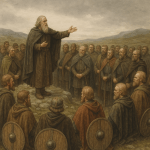
In medieval Scandinavia, thing assemblies functioned as local and provincial gatherings and, in Iceland, as national assemblies of freemen. They formed a fundamental unit of government and law. These assemblies were presided over by a local chieftain or by a law-speaker, a person learned in the unwritten law and responsible for helping preserve and recite it. Source
The þing therefore stood at the center of Norse legal culture. It was a place where disputes could be heard publicly rather than settled only through private violence. The assembly gave the community a structured way to address conflict, and it made law visible as a shared social practice rather than a hidden command from above. Source
Free men, community judgment, and dispute resolution
The sources describe the þing as an assembly of free people, especially free men, who gathered to make law and decide cases. This is a crucial point for understanding Norse legal order: the assembly was not an abstract institution separated from society, but a communal forum in which those recognized as free had a role in legal life. Source
Disputes were handled through public debate and community consensus. Rather than relying only on force, Norse society developed a legal framework in which cases could be argued before the assembly. Some modern summaries describe this as an early jury-like process, emphasizing the collective and deliberative character of the proceedings. Source
This does not mean that violence disappeared from Norse life. The Viking Age was still a period of conflict and local power struggles. But the existence of the þing shows that Norse communities also valued legal settlement and public order. The legal assembly offered a recognized path for resolving conflict within the social world of the North. Source
Oath-taking and the authority of law
Oaths were central to Norse legal culture. In a society where law was often unrecorded and preserved through memory, oath-taking helped bind individuals to public commitments and legal outcomes. The þing was a fitting setting for such acts because it was a communal and authoritative space. The public nature of the assembly gave oaths social force, since they were witnessed by the community rather than made in private.
In this sense, the þing was not only about judging disputes after they arose. It also helped maintain trust in the legal order itself. Oaths, declarations, and public procedure reinforced the idea that law belonged to the community and had to be enacted before witnesses.
The law-speaker and the memory of law
Because much Norse law was not written down in the Viking Age, the role of the law-speaker was especially important. Britannica notes that the þing could be presided over by a law-speaker, described as unusually learned in the unrecorded law. This figure helped preserve legal continuity by remembering and reciting the law at the assembly. Source
The law-speaker’s authority depended on knowledge, memory, and public performance. In a culture where oral transmission mattered deeply, the law-speaker embodied the connection between tradition and procedure. The office shows how Norse legal life relied on skilled human memory rather than written codes alone. Source
Political power and the place of the þing
The þing also belonged to the political structure of Norse society. During much of the Viking Age, power was largely in the hands of chieftains, while political authority remained divided across different regions. In that fragmented landscape, assemblies helped organize local authority and provide a forum where power could be negotiated publicly. Source
This is why the þing should be understood as both legal and political. It was a place where disputes were settled, but also where leadership, influence, and communal order were expressed. The assembly did not erase hierarchy, yet it gave free men a recognized role in the governance of their communities. Source
From local assemblies to broader institutions
The sources also point to the broader development of thing assemblies in the North Atlantic world. Things were found throughout Northern Europe, and in Iceland these assemblies ultimately led to the founding of the Althing, the Icelandic parliament. Source Source
This development shows that the þing was not a marginal custom. It was a durable institution with regional variation and long influence. Its survival in different forms across the Norse world demonstrates how deeply legal assembly was woven into Scandinavian social life. Source
The þing in Norse cultural memory
For students of ancient Norse mythology and culture, the þing is significant not only as a legal institution but also as part of the broader Norse worldview. The assembly reflects values of speech, witness, memory, and communal obligation.
Even where the surviving sources are historical rather than mythological, the þing belongs to the same cultural landscape as saga literature and the oral preservation of law. It reveals a society in which order was negotiated publicly and where law was a living part of communal identity.
Why the þing matters
The Norse þing was a legal assembly, a political forum, and a cultural institution. It helped communities resolve disputes, uphold oaths, and preserve law through the authority of the law-speaker. It also shows that ancient Norse society was not governed only by force. It had structured legal practices that depended on public participation and collective memory. Source
For anyone studying Norse law and justice, the þing is essential. It reveals how the Norse legal order worked in practice and why assemblies remained central to Scandinavian political life for so long.
References
- Old Norse Law: How the “Thing” and the Jury System Governed the North
- Viking Political Institutions – Norse Mythology for Smart People
- Thing (assembly) – Wikipedia
- Thing | Viking Age, Norse Law & Norse Society | Britannica
- Law and Order – Follow the Vikings
- Viking Law and Government: The Thing And Its Application – History