
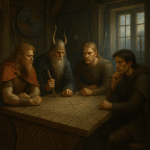
The Aesir as a Political Order: Power, Alliances, and Rivalries
The Aesir are often remembered as individual gods with famous powers, but Norse myth also presents them as a ruling order. Their world is shaped by leadership, negotiation, loyalty, rivalry, and the fragile bonds of oath and kinship. Looking at the Aesir politically reveals a divine society held together by alliance as much as by force.

The Aesir as a ruling order
When people first meet the gods of Norse myth, they often encounter them one by one: Odin the wise, Thor the strong, Frigg the knowing, Tyr the just. Yet the Aesir are not simply a collection of separate figures. They form a divine community with its own hierarchy, obligations, and tensions. In many myths, they behave less like distant supernatural beings and more like a ruling class trying to govern a dangerous world.
This political reading of the Aesir helps explain why so many stories involve councils, bargains, feuds, and oaths. Power among the gods is not absolute. It is negotiated. Authority depends on reputation, kinship, wisdom, force, and the ability to hold alliances together. The result is a mythic society that feels alive, unstable, and deeply human.
Leadership without a single throne
Unlike a kingdom with one fixed monarch, the Aesir do not appear to be ruled by a simple, permanent system. Odin is often treated as the most prominent of the gods, especially in matters of wisdom, war, and magic. He is a seeker of knowledge and a maker of plans. But prominence is not the same as uncontested rule. Other gods have their own spheres of influence, and their authority can be strong in different contexts.
Thor, for example, is often portrayed as a central defender of divine order. His strength gives him enormous weight in the community. Tyr is associated with law, courage, and the binding force of oath. Frigg is associated with foresight, household authority, and high status. These roles suggest a shared governance rather than a single all-powerful ruler.
In myth, leadership among the Aesir often looks like a balance of functions. One god may lead in battle, another in counsel, another in sacred knowledge, and another in the maintenance of social bonds. This division of power makes the Aesir feel like a court, a war band, and a family all at once.
Councils, negotiation, and divine politics
Many Norse myths show the gods discussing problems together. They debate, plan, and sometimes fail to agree. This is important because it suggests that the Aesir are not merely acting on instinct or divine will. They deliberate. They weigh consequences. They are political actors.
These gatherings are often moments when the fragility of order becomes visible. The gods may need to respond to threats from giants, manage the consequences of broken promises, or decide how to deal with dangerous knowledge. Their discussions reveal that even divine power requires coordination. A strong ruler cannot simply command reality into obedience.
The mythic world therefore depends on consensus as much as force. The Aesir must persuade one another, not just overpower enemies. That makes their society feel closer to a human polity than to a perfect heavenly realm.
Oaths as the foundation of order
In Norse tradition, oaths were treated as serious and binding. This idea appears strongly in myths about the Aesir. Oaths help define who belongs, who can be trusted, and what happens when loyalty fails.
The gods’ political world is built on promises, but those promises are always under pressure. A broken oath can unravel alliances and invite catastrophe. This is one reason why oath-making matters so much in stories involving the Aesir. It is not just a moral detail. It is the mechanism that holds society together.
Tyr’s association with law and sacrifice is especially revealing here. In myth, he is linked to the cost of maintaining order, even when that cost is severe. The idea is clear: governance requires commitment, and commitment may demand loss. The Aesir do not preserve order by sentiment alone. They preserve it through binding acts that carry real consequences.
Alliances, kinship, and marriage
Like many ruling groups, the Aesir rely on alliances. These alliances are not only military. They are also familial and marital. Marriage in myth often serves as a bridge between households, clans, and even different kinds of beings. Such unions can stabilize relationships, create peace, or bring new tensions into the divine community.
Kinship is equally important. The Aesir are tied together by family lines, foster relationships, and shared history. But kinship does not eliminate rivalry. In fact, it can intensify it. Brothers may compete, spouses may disagree, and relatives may be drawn into conflicts that affect the whole order.
This is one of the most striking features of the Aesir: their unity is real, but never simple. They are bound together by blood and obligation, yet they remain individuals with competing interests. That tension gives Norse myth much of its energy.
Rivalries inside the divine household
The Aesir are often in conflict with outside forces such as giants, but internal rivalry is just as important. Some of the most memorable myths involve suspicion, insult, competition, or betrayal within the divine group itself. These stories remind us that power is never fully secure.
Rivalry among the gods can take many forms. It may appear as a contest of wisdom, a struggle over honor, or a clash between different styles of authority. Odin’s hunger for knowledge can create unease. Thor’s directness can contrast with more subtle forms of power. Loki, though often treated as moving among the gods, exposes the instability of the whole order by provoking, testing, and disrupting social bonds.
These tensions do not mean the Aesir are weak. Rather, they show that political order is always contested. A ruling class must manage ambition, pride, and distrust from within as well as threats from outside.
Loki and the pressure on the system
No discussion of Aesir politics is complete without Loki. He is not a straightforward member of the ruling order, even when he moves among the gods as one of them in some stories. Loki functions like a stress test for divine society. He reveals how dependent the Aesir are on trust, and how quickly trust can fail.
Sometimes Loki helps the gods. Sometimes he harms them. Often he does both. This ambiguity makes him especially important in a political reading of the myths. He is a figure of instability, but also a mirror of the instability already present in the divine world. The Aesir are not threatened only by enemies beyond their walls. They are threatened by the possibility that their own bonds may break.
In that sense, Loki is not just a trickster. He is a reminder that every political order contains the seeds of its own disruption.
Governance, not perfection
Seeing the Aesir as a political order changes how we read Norse myth. The gods are not presented as flawless ideals. They are powerful, but they must work to maintain authority. They negotiate, bargain, swear, punish, and sometimes fail. Their world is held together by relationships that are strong but never guaranteed.
This makes the myths feel grounded in the realities of human society. Leadership is difficult. Alliances are fragile. Oaths matter. Rivalries can destroy what cooperation builds. The Aesir embody all of these truths in divine form.
Rather than standing above politics, they are immersed in it. Their stories show that order is not a natural given. It is something made, defended, and constantly at risk.
Why this matters
Thinking of the Aesir as a political order helps us understand why Norse mythology feels so dynamic. The gods are not static symbols. They are participants in a living system of power. Their relationships shape the fate of the cosmos, just as human relationships shape the fate of communities.
That is part of the enduring appeal of the Aesir. They are divine, but they are also recognizably social. They rule through alliance, struggle with rivals, and depend on the very bonds that can also undo them. In their world, governance is never simple, and that is what makes it so compelling.