Ymir’s Body and the Making of the Norse Cosmos: Norse creation myth
In Old Norse cosmology, creation begins not with gentle ordering but with a violent transformation of the primeval giant Ymir. This article traces how Odin, Vili, and Vé fashion...

Ymir’s Body and the Making of the Norse Cosmos
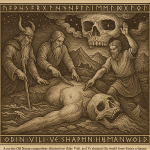
The Norse creation myth is one of the most vivid cosmogonies in Old Norse tradition. It does not imagine the world as being made from nothing in a calm or abstract act of divine speech. Instead, the cosmos is formed from a slain being: Ymir, the primeval giant. In the familiar account preserved in later retellings of Norse cosmology, Odin and his brothers Vili and Vé kill Ymir and use his body to shape the world. From this act of cosmic violence comes order, structure, and the inhabited world.


This myth is central to the study of Ancient Norse mythology because it links creation, sacrifice, and cosmic geography. It explains where the earth came from, why the sea surrounds the land, and why the sky arches overhead. In that sense, Ymir’s body is not merely a source material for the world; it is a mythic map of the cosmos.
The Primeval Beginning: Ymir and Ginnungagap
The creation story begins in the void of Ginnungagap, the yawning emptiness that precedes the ordered cosmos. In this primordial space, Ymir appears as the first giant, a being associated with the earliest and most chaotic phase of existence. The source material describes Odin, Vili, and Vé taking Ymir’s corpse to the center of Ginnungagap and carving it apart to make the world. This is a foundational image in Norse cosmology: the cosmos emerges from a body placed within the void and transformed into a habitable structure.
For readers of Old Norse myth, this is an important reminder that creation in the Norse tradition is often relational and material. The world is not separated from the giant body that precedes it; rather, it is made out of that body. The old order of chaos is not erased so much as repurposed.
How the World Was Made from Ymir’s Body
The myth assigns specific parts of Ymir’s body to specific features of the cosmos. This is one of the clearest examples of symbolic correspondence in Norse mythological thought.
The Earth from Flesh
Ymir’s flesh becomes the earth. Some source summaries also describe his flesh as becoming dirt or soil. This gives the land itself a bodily origin. The ground beneath human feet is therefore not neutral matter, but the transformed substance of the primordial giant.
The Sea from Blood
Ymir’s blood becomes the sea, and in related retellings, lakes, oceans, rivers, or other waters as well. This detail is especially striking because it explains the vastness and enclosing power of water in the Norse world. The sea is not simply a feature of the landscape; it is the outflow of a slain cosmic being.
Mountains, Rocks, and Stones from Bone and Teeth
Ymir’s bones become mountains, while his teeth and molars become rocks, scree, and stone. In some retellings, remaining bone fragments also contribute to the rocky terrain. The result is a landscape built from the giant’s skeleton.
The Sky from the Skull
Ymir’s skull becomes the sky. The image is one of the most memorable in Norse cosmology: the heavens are not an abstract expanse but a dome made from a giant’s head. The sky is placed above the earth, and some accounts say it is held in place at four points by dwarves corresponding to the cardinal directions.
The Sea as a Circle Around the Land
According to the source material, the gods surrounded the earth’s lands with sea, forming a circle. This helps explain the spatial logic of the Norse cosmos. The inhabited land is enclosed by water, which marks a boundary between the human world and the wider expanse beyond it.
The Human World
Some source summaries state that Odin and his brothers used Ymir’s body to create Midgard, the human world. More generally, the myth presents the inhabited world as part of a larger cosmos shaped from the body of a primordial giant.
The human world is not created in isolation. It is part of a larger cosmos that includes other realms and beings. The myth emphasizes that human life exists within a universe shaped by the remains of older, more chaotic powers.
The Shape of Norse Cosmology
The Norse cosmos is often described as a structured whole rather than a single flat plane. In this creation myth, Ymir’s body provides the material basis for that structure.
The sky, earth, sea, and mountains are not isolated features. They belong to a larger cosmological order in which different realms are connected, separated, and supported. The myth therefore does more than explain physical features. It establishes the logic of the Norse universe: a world made from a giant’s body, organized into distinct regions, and held together by divine action.
Why This Creation Myth Matters
The story of Ymir’s body is not only a creation tale; it is also a statement about how the Norse imagined order emerging from violence, sacrifice, and transformation. The gods do not create by speaking the world into existence. They create by killing, carving, and arranging.
For students of Ancient Norse mythology, this matters for several reasons. First, it shows how Old Norse tradition uses bodily imagery to explain the natural world. Second, it reveals a cosmology in which the landscape is deeply meaningful, with each feature tied to a mythic origin. Third, it helps explain why the Norse cosmos feels so material and immediate: the earth is flesh, the sea is blood, and the sky is a skull.
The myth also places the gods in a role that is both creative and destructive. Odin, Vili, and Vé are not distant architects. They are agents who impose order on a preexisting giant body. In this way, the creation of the world is inseparable from the death of Ymir.
Ymir in Old Norse Tradition
Ymir appears in the broader mythic tradition as a primordial giant associated with the earliest phase of existence. The source pack notes that these events are recorded in Grímnismál. In that poetic tradition, the world’s features are traced back to Ymir’s flesh, sweat or blood, bone, hair, and skull. Different retellings emphasize different body parts, but the core idea remains the same: the cosmos is assembled from the giant’s remains.
This variation is useful rather than confusing. It shows that Norse myth was preserved through multiple poetic and prose traditions, not through a single fixed version. The creation story is stable in its main structure, but flexible in its details.
Reading the Myth as Cosmological Language
Ymir’s body can be read as a kind of cosmological language. Each body part corresponds to a feature of the world, and each feature helps explain how the cosmos is ordered. Flesh becomes land. Blood becomes sea. Bone becomes mountain. Skull becomes sky.
That transformation is one reason the story remains so powerful. It gives the world a body and gives the body a world. The result is a creation myth that is at once poetic, violent, and deeply structured.
Conclusion
The making of the Norse cosmos begins with Ymir’s death, but the myth is less about destruction than about transformation. Odin, Vili, and Vé take the body of the primeval giant and turn it into the earth, the sea, the mountains, the sky, and the inhabited world. In doing so, they establish the shape of the cosmos and the place of human life within it.
For anyone studying Ancient Norse mythology, Ymir’s body is one of the most important images in the creation tradition. It shows how the Norse imagined the universe as a living, material, and morally charged structure. The world is not simply made; it is made from someone.
References
- Norse cosmology – Wikipedia — used for the body-to-cosmos correspondences and the role of Odin, Vili, and Vé.
- Ymir in Norse Mythology: A Cosmic Creation Story – Ancient Origins — used for the summary of Ymir’s destruction and the creation of the world from his body.
- The Creation of the Cosmos – Norse Mythology for Smart People — used for the broader cosmogonic framing and the skull-sky image with four dwarves.
- The Norse Creation of the Cosmos – EBSCO Research Starters — used for the concise account of the corpse-to-world transformation and the sky being held by four dwarves.