Blót in Practice: How Norse Sacrifice Structured Community, Season…
Blót was more than sacrifice: it was a structured communal act that linked gods, spirits, seasonal change, hospitality, and local authority. This article examines how offerings...

Blót as a Ritual Core of Norse Religion
Blót was a central ritual practice in ancient Norse religion. The source material describes it as a sacrificial ceremony involving offerings to gods, spirits, and other powers believed to affect human life and prosperity. In practice, blót was not a marginal act of devotion. It stood at the center of religious life, linking worship, communal feasting, and the well-being of the group.
For students of Old Norse religion, blót is important because it shows how ritual was embedded in everyday social structures. It was not only about private piety. It also expressed communal identity, seasonal rhythm, and the authority of local leaders who presided over the rite.
Offerings: Mead, Ale, Food, and Livestock
The source pack identifies offerings of mead, ale, and food as part of blót. Literary sources also suggest that livestock could be offered, and some accounts mention living sacrifice in major ceremonies. In historical descriptions, animals were sometimes sacrificed and their meat prepared and shared among participants.
This detail matters because it shows that sacrifice was not simply destruction. It was also redistribution. The offering could become part of a feast, turning ritual into a shared meal that reinforced hospitality and solidarity. In this sense, blót joined the sacred and the social in a single event.
As one source summary notes, blót ceremonies could involve offerings to gods and spirits, with communal feasting at the center of the rite. Another source describes the sharing of meat after sacrifice as part of the ceremony’s social function. [1] [2]
Seasonal Cycles and Fixed Times of Blót
Blót was often tied to the calendar. The source pack notes that some blóts were held annually and marked seasonal change. One source also states that there were believed to be four fixed blót sacrifices a year, though the exact details of this cycle are not fully preserved in the source material. [3]
This seasonal pattern is significant. It suggests that blót helped communities mark time through ritual rather than through abstract chronology alone. Seasonal sacrifice connected religious observance with agricultural life, weather, and practical concerns of survival. The rite could also be performed before expeditions, duels, funerals, or other important events, showing that blót was flexible enough to address both recurring cycles and urgent moments. [4]
Local Leaders and Communal Authority
Blót also reveals how religious authority worked in Norse communities. According to the source pack, larger ceremonies took place at magnates’ residences, where farmers from the surrounding area gathered for a great sacrifice. At these events, the local magnate could function as a pagan ritual leader. [3]
This arrangement shows that blót was not only a religious ceremony but also a public demonstration of leadership. The magnate’s role in presiding over sacrifice linked sacred authority to local power. The gathering of farmers at the magnate’s residence made the rite a social event as well as a devotional one. In this setting, ritual reinforced hierarchy while also creating a shared religious space for the community.
The source material also suggests that smaller rituals may have been practiced on farms, while larger ceremonies were reserved for more prominent households or residences. This distinction helps explain how Norse religion could operate at multiple levels: domestic, local, and communal. [3] [5]
Feasting, Hospitality, and Social Bonding
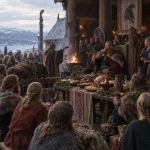
One of the clearest features of blót is the way it joined sacrifice to feasting. The sources describe communal meals in which the meat from sacrificed animals could be shared among participants. This made the rite a form of ritual hospitality. The feast was not an optional addition to sacrifice; it was part of the ceremony’s meaning.
By eating together after the offering, participants affirmed mutual obligation and group belonging. The feast transformed sacrificial action into a visible social bond. It also made the ritual memorable and public, strengthening the connection between religious observance and community life.
In this respect, blót can be understood as a mechanism for maintaining cohesion. It brought together worship, food distribution, and collective participation in a single structured event. The source pack repeatedly emphasizes this communal dimension. [1] [2]
Sacred Space: Farms, Residences, and Ritual Gathering Places
Blót was performed in specific places that became sacred through use. The source pack points to small farms, magnates’ residences, and larger ceremonial spaces as settings for ritual. Another source notes that archaeological evidence has been interpreted to suggest that pagan temples functioned as places for communal feasts and blóts held by kings or local leaders. [4]
This means that sacred space in Norse religion was often practical and local rather than abstract or detached from daily life. A hall, residence, or farmstead could become ritually significant when the community gathered there for sacrifice and feast. The sacred was thus created through action, not merely marked by permanent architecture.
For modern readers, this supports a picture in which ritual space was flexible, communal, and tied to the authority of household heads, magnates, or local leaders. The place mattered because the rite happened there, and because the community recognized it as a site of sacred exchange.
Public and Private Religion in Norse Practice
The source material indicates that private religion often paralleled public religion, though the boundary between the two is difficult to draw. Yearly blót feasts and life-passage or crisis rituals could belong to either sphere. In the private sphere, the head of the household and his wife could lead the rite. [5]
This overlap is useful for understanding Norse religious life as a continuum rather than a rigid division. A blót could be household-based or community-wide, depending on scale and purpose. What remained consistent was the ritual logic: offering, invocation, participation, and the reinforcement of social and spiritual bonds.
What the Sources Allow Us to Say
The source pack supports a clear picture of blót as a sacrificial and communal rite. It involved offerings of drink and food, sometimes livestock, and in some accounts living sacrifice. It could be tied to seasonal change, major life events, or communal gatherings. It was often led by local elites or household heads, and it helped structure both sacred space and social order.
At the same time, the evidence is uneven. The sources preserve broad patterns rather than a single fixed liturgy. That means blót should be understood as a family of related ritual practices rather than one standardized ceremony. Even so, the recurring themes are strong enough to show why blót mattered so deeply in ancient Norse communities: it was a way to honor divine powers, sustain the group, and mark the rhythm of the year.
Conclusion
Blót was one of the most important ritual forms in Norse religion because it united sacrifice, feasting, leadership, and seasonal life. It structured community by bringing people together around offerings and shared meals. It structured season by marking recurring times of observance. And it structured sacred space by turning farms, halls, and residences into places of ritual significance.
For anyone studying ancient Norse mythology, history, or religion, blót offers a direct window into how ritual worked in practice. It was not only an act of devotion. It was also a social institution, a calendar marker, and a public expression of communal belonging.