Exploring the Realms of Law & Justice in Norse Mythology

Introduction to Law and Justice in Norse Culture
In the rich tapestry of Norse mythology, the concepts of law and justice stand out as fundamental pillars that not only shaped the moral framework of the Norse people but also influenced their myths and legends. Unlike the simplistic portrayal of Vikings as lawless raiders, historical texts and mythological stories suggest a society governed by a complex system of laws and a keen sense of justice. This post delves into how these concepts were integrated into Norse life and mythology, reflecting a sophisticated understanding of order and fairness.
The Historical Context of Norse Law
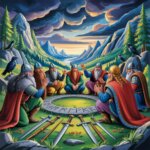
The Norse were not a unified nation but a collection of tribes spread across Scandinavia and the Norse settlements in the British Isles, Greenland, and beyond. Each of these communities was governed by local laws and practices, usually determined in gatherings known as ‘Things’ or ‘Alþingi’ in Old Norse. The ‘Thing’ was both a legislative assembly and a courtroom where disputes were settled, laws were made, and justice was administered publicly.
This system did not merely handle mundane legal disputes but was also deeply intertwined with their cosmic worldview, linking the social order with the divine. Laws were not seen as man-made but as extensions of the universe’s order, often with attributed divine origins or blessings.
Mythological Underpinnings: The Role of the Gods
In Norse mythology, several deities are associated directly with the maintenance of law and order. The most significant among them is Tyr, the god of war and justice. Tyr is particularly noted for his bravery and his role in the binding of Fenrir, a myth that allegorically underscores his association with law and sacrifice for the greater good. His willingness to place his hand in Fenrir’s mouth as collateral during the binding of the great wolf symbolizes the solemnity of oaths and the consequences of breaking them.
Moreover, the Aesir-Vanir war, a central myth in Norse lore, provides insights into the negotiation and restoration of peace and order. The truce following this cosmic conflict led to the exchange of hostages amongst the gods, demonstrating a legal resolution familiar to Norse societies who practiced similar exchanges to settle disputes among clans.
Legal Rituals and Symbols
Rituals and symbolic acts played a significant role in Norse legality. The ‘hlauttein’, a ritualistic twig, was dipped in sacrificial blood and used to sprinkle on people and legal documents, perhaps sanctifying the agreements in the eyes of the gods. Another critical aspect was the ‘varðlokkur’, incantations sung to ward off evil spirits during legal proceedings, emphasizing the spiritual dimension of Norse law.
Thingvellir: A Symbol of Norse Justice
Thingvellir, a national park in modern-day Iceland, was once the location of the Alþingi, one of the earliest and most significant legislative assemblies in Norse culture from AD 930 till the late 18th century. Here, law-speakers would recite existing laws during the assembly, and new laws were decided. This site is not only a geographical but a cultural representation of Norse law, reflecting its communal and transparent nature.
Ethical Dimensions in Norse Legends
Norse myths often reflect on moral concerns regarding justice, loyalty, and honor, which can be seen in the sagas. For instance, the Volsunga Saga, filled with themes of oath-breaking and revenge, deeply explores the ethical consequences of each character’s actions against the backdrop of their legal and societal norms. It’s a testament to how intertwined law, lore, and ethics were in the Norse worldview.
Justice Beyond Humans: The Cosmic Law
In Norse cosmology, the concept of ‘Orlog’—a kind of primal law—also plays a crucial role. Unlike the mutable laws created in the ‘Things’, Orlog is an immutable force that governs the destiny of gods and men alike. This cosmic law feeds into the idea that actions and consequences are bound by a universal order, which even the gods cannot escape. The notion of Ragnarok, the prophesized end of the cosmos where many gods meet their fate, is an ultimate enactment of this cosmic justice.
Conclusion
The integration of law and justice into every aspect of Norse life, from their local community assemblies to their cosmic mythology, underlines the importance of these concepts in Viking age Scandinavia. Unlike the stereotypical image of marauding Vikings, the Norse were a people deeply engaged with issues of legality and morality, both in this world and in the metaphysical. Their sophisticated legal system not only highlights advanced social structures but also presents a worldview in which everything is subject to a greater order, tethered firmly to their rich mythological traditions.
In exploring the Norse views on law and justice, we not only gain insight into their culture and societal norms but also understand the universal questions of ethics and order that continue to resonate today. The portrayal of these themes through their myths and sagas adds a profound dimension to our understanding of the ancient Norse, inviting us to reconsider the narratives of history and the complexities of human societies.