Exploring Norse Burial Customs: Rituals of the Viking Age

Introduction to Norse Burial Customs
The burial customs of the Norse people during the Viking Age (circa 793-1066 AD) were as varied and complex as their beliefs about the afterlife. Not simply rites of mourning, these customs were deeply woven into the Norse understanding of the cosmos, the soul’s journey, and the continuation of prestige and memory within their communities. By examining these ancient rituals, we uncover a nuanced tapestry of Norse spiritual life, societal values, and cosmological beliefs.
The Significance of Norse Burial Practices
Norse burial customs were primarily influenced by the era’s predominant religion, which worshipped a pantheon that included gods like Odin, Thor, and Freyja. These deities governed not just natural elements but also the aspects of war, wisdom, and death. Such beliefs were integral in shaping the Vikings’ approach to death, leading to practices aimed at ensuring safe passage and an honorable remembrance.
In the Viking worldview, death was not an end but a transition to another existence, such as Valhalla, the hall of the slain warriors ruled by Odin, or Hel, a realm for those who died of illness or old age. The customs surrounding burial were therefore crucial to ensure the deceased was properly equipped for their journey into the afterlife.
Types of Norse Burials
The Vikings practiced several types of burials, with choices often influenced by social status, local customs, and the wealth of the deceased. Two of the most prominent types of burials were inhumation and cremation.
Inhumation
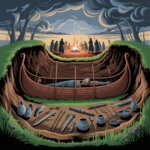
Inhumation involved burying the body intact, with grave goods that could range from weapons and jewelry to tools and household items. This type of burial often included a burial mound, a ship setting (where ships are buried along with the deceased), or a simple grave marked by stones. Excavations of such sites have revealed gender roles and social hierarchy; for instance, weapons in a grave typically signify a male, whereas household utensils or needlework often denote a female.
Cremation
Cremation was equally significant and thought to expedite the soul’s journey to the afterlife, with the flames helping to purify the deceased and the rising smoke carrying them to the afterlife. The ashes would then be buried in an urn, accompanied by grave goods. This practice was particularly prominent in areas like Uppsala in Sweden, where large cremation graves have been found.
Rituals and Grave Goods
The items chosen as grave goods were profoundly symbolic, representing the deceased’s life and status. Warriors might be buried with their weapons, ships, and even sacrificed animals or slaves—a practice evident in ship burials such as those discovered at Oseberg and Gokstad in Norway. These graves not only signify the dead’s social standing but also their readiness to continue their roles in the next life.
Women’s graves often included keys (symbolic of their role as keepers of household properties) and weaving equipment, underscoring their responsibilities in life. These artifacts highlight the belief in a life beyond death where everyday activities and roles would perhaps continue.
Ship Burials and Their Significance
Among the most dramatic and celebrated of Norse burial practices were ship burials. Not merely a method to inter the esteemed dead, the ship served as a vessel to carry them into the afterlife, reflecting their seafaring culture and the importance of travel and conquest in Norse life. The ships, filled with provisions, goods, and sometimes human and animal sacrifices, were interred whole or in parts, accompanied by elaborate ceremonies.
The most iconic examples include the Oseberg ship, which was discovered with two women of high status, and the Gokstad ship, which held a king or chieftain. These findings, laden with rich goods and intricate decorations, reflect a complex ritualistic approach and a belief system interwoven with maritime prowess.
Conclusion: The Legacy of Norse Burial Customs
The burial customs practiced by the Norse were more than mere funeral rites; they were a reflection of a worldview rich in symbolism, spirituality, and social stratification. These customs offer fascinating insights into Viking society, revealing a culture that celebrated life, prepared meticulously for death, and held profound beliefs in an afterlife.
Today, archaeological excavations at burial sites continue to unravel the complex tapestry of the Viking Age. Each mound and grave tells a story not just of individual lives but of a broader cultural narrative that continues to captivate and educate us about the intricate practices of the Norsemen.