Runes in Daily Life: How Norse Symbols Moved from Carvings to Amulets
Runes in the Norse world were not confined to memorial stones. They also appeared on tools, weapons, jewelry, household objects, and amulets, where carving could serve...

Runes Beyond the Monument
When many people think of Norse runes, they picture carved stones standing in the landscape. That image is important, but it is only part of the story. In the Viking Age and related Germanic contexts, runes also appeared on objects used in ordinary life, including brooches, weapons, implements, jewelry, and other portable items. These inscriptions show that runic writing was not reserved for grand public display. It also belonged to the practical, personal, and ritual worlds of Norse households and communities.
Surviving evidence suggests that runes could preserve memory, express intention, and provide protection. In that sense, they were both writing and symbolic action. Carving runes was not treated as a neutral act. It could be understood as deliberate and meaningful, especially when the inscription was placed on an object meant to accompany a person through daily work, travel, or danger.
Runes in the Home and Household
Archaeological evidence shows runic inscriptions on everyday artefacts from Viking towns and marketplaces, as well as on household goods. This matters because it places runes inside daily life rather than only in elite or ceremonial settings. A household object with runes could be practical, but it could also carry symbolic force.
In a Norse home, carved objects may have served several overlapping purposes. A brooch or piece of jewelry could display status or memory. A small inscription might also be intended to protect the object, the person using it, or the household itself. The same object could therefore be functional and meaningful at once.
This blending of use and symbolism fits the broader character of Norse art. Ornament was not merely decorative. It could communicate identity, belief, and intention. A carved line, a name, or a symbol on a domestic object could turn an ordinary item into something charged with significance.
Trade and Everyday Exchange
Runes also belonged to the world of exchange. In marketplaces and towns, portable objects moved from hand to hand, and inscriptions could mark objects in circulation. Implements and small personal items could all carry runic marks. Such markings show how writing entered the practical economy of the Norse world.
Because Norse society was strongly oral, runes were not used for every kind of writing in the way later literate cultures used parchment and books. Instead, they were often carved into durable materials such as wood, stone, metal, or bone. Their angular forms suited this medium. The result was a writing system closely tied to material culture: the object itself became the surface on which language, memory, and symbolism met.
In trade settings, this mattered in a very concrete way. A marked object could be recognized, dedicated, or protected. The inscription was not separate from the item’s use; it was part of how the item functioned in society.
Protective Inscriptions and Personal Power
One of the most striking features of Norse runic culture is the association between writing and power. The source pack notes that runes were used for protective inscriptions and magical purposes. They were engraved on amulets and also appeared on weapons and other objects associated with defense and empowerment.
This does not mean every runic inscription was magical. Some were commemorative, some practical, and some probably decorative. But the evidence does support a strong connection between runes and intentional action. To carve a rune could mean more than to record a word. It could be an act meant to influence the world.
That helps explain why runes appear on objects carried close to the body. Amulets and pendants are especially important here. A small object worn on the person could serve as a visible sign of belief, identity, or protection. In this context, the symbol was not distant or monumental. It was intimate, portable, and active in daily life.
Thor’s Hammer Pendants and Protective Symbolism
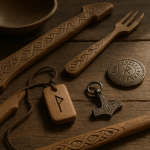
Among the best-known Norse protective objects are Thor’s hammer pendants. The source pack identifies these as amulets and talismans associated with protection. Their popularity reflects the broader Norse habit of combining symbolic form with practical use. A pendant could be worn as jewelry, but it could also function as a statement of allegiance to divine protection and cosmic order.
Runic charms and related symbols worked in a similar way. They were not simply images to be admired. They were objects to be carried, worn, or kept close. In that sense, they belong to the same world as household tools and weapons: the world of lived, embodied Norse symbolism.
Weapons, Tools, and the Language of Protection
Runes were also carved on weapons and tools. The source pack notes inscriptions on weapons, implements, and other objects, showing that runes could accompany both violence and labor. This is a useful reminder that Norse symbolism was not confined to religious or ceremonial spaces. It was woven into the practical realities of survival, status, and conflict.
A weapon inscribed with runes could be more than a weapon. It could be marked or empowered. A tool could be more than a tool. It could be protected or ritually charged. In both cases, the inscription helped transform the object from a simple instrument into something with social and symbolic presence.
Because runes were carved into durable materials, many surviving examples come from objects that were meant to endure. That durability is part of their meaning. A carved mark on metal or bone could outlast the moment of use and continue to speak across time.
Commemoration, Memory, and the Everyday Sacred
Runes were not only practical or protective. They were also used to preserve memory. Memorial stones are the most visible examples, but the same impulse appears in smaller objects as well. A runic inscription could keep a person’s name present or record a relationship.
This is one reason runes should be understood as part of everyday Norse spirituality rather than as a separate “magical” category. The sacred and the practical were often intertwined. A household object could be useful and meaningful. A pendant could be decorative and protective. A carved inscription could preserve memory while also shaping the present.
The source pack emphasizes that runes were understood as symbols capable of preserving memory, expressing intention, and connecting the human world with a broader cosmological order. That captures the depth of Norse symbolic practice. Runes were not merely letters. They were part of how people made sense of the world around them.
Why the Carving Itself Mattered
In Norse contexts, the act of carving mattered as much as the finished object. To cut a rune into wood, stone, metal, or bone was to perform a meaningful action. The maker was not simply decorating a surface. They were engaging with language, memory, and power through material form.
This helps explain why runic inscriptions appear on such a wide range of objects. The same writing system could be used for commemoration, protection, and expression because the act of inscription itself carried significance. The object became a site where intention was made visible.
For students of Norse art and symbolism, this is a crucial point. Norse visual culture was not limited to images of gods, beasts, or heroic scenes. It also included signs, letters, and carved marks that worked in close relation to daily life. Runes were part of that visual and material language.
Reading Norse Symbols in Context
Modern audiences often separate “art,” “writing,” and “magic” into distinct categories. The Norse evidence suggests a more integrated world. A runic inscription on a comb, a brooch, or a weapon could combine ownership, memory, protection, and crafted visual form.
That is why it is important to read Norse symbols in context. A rune on a memorial stone is not the same as a rune on a pendant, and a rune on a weapon is not the same as a rune on a marketplace object. Yet all of them show how deeply runic writing was embedded in Norse life.
For this reason, runes should be understood not only as a writing system but also as a material practice. They moved from monumental carvings into the intimate spaces of the home, the body, the workshop, and the market. In doing so, they reveal a Norse world in which symbols were lived with, carried, and used.
Conclusion
Runes in the Norse world were never limited to stone monuments. They appeared on everyday objects, in trade settings, on weapons and tools, and on amulets worn for protection. Their use shows how Norse art and symbolism operated in daily life, where practical function and ritual meaning often overlapped.
From household goods to Thor’s hammer pendants, runic inscriptions helped Norse people preserve memory and engage with forces beyond ordinary speech. They remind us that in the Viking Age, writing could be material, symbolic, and powerful all at once.