
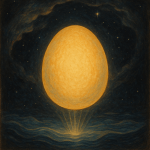
The Cosmic Egg Across World Traditions
Across many creation stories, the universe begins in a surprising form: an egg. This article explores the cosmic egg motif in world traditions, showing how a single primordial object can represent birth, order, potential, and the unfolding of everything that exists.

Introduction: Why the Cosmic Egg Appears in Creation Stories
Creation myths often begin with images that help people imagine the beginning of everything. One of the most striking of these images is the cosmic egg. In many traditions, the universe does not begin as a finished world, but as a sealed, fertile, mysterious object containing possibility. From that egg, the sky, earth, gods, and living beings may emerge.
The cosmic egg is powerful because it is both simple and profound. An egg suggests life, protection, hidden growth, and a moment of breaking open. It is a natural symbol for beginnings, yet it also carries a sense of mystery. What is inside is not yet visible, but it is already imagined as real. That makes the cosmic egg a fitting image for creation itself, much like other mythic attempts to picture the first moment before the world takes shape.
Although the details differ from culture to culture, the motif often serves similar purposes. It explains how order can arise from chaos, how a unified whole can split into distinct parts, and how life can emerge from something enclosed and seemingly inert. Looking across traditions, we can see both shared human imagination and unique cultural meaning. For readers interested in ancient Norse mythology, this wider comparison is especially useful, since Norse creation stories also wrestle with the movement from primal disorder to a structured cosmos, even without centering on an egg.
What the Cosmic Egg Represents
Before looking at specific traditions, it helps to understand the symbolic roles the cosmic egg often plays. In many myths, it is not just a container. It is a complete image of the universe in potential form.
Potential and hidden life
An egg contains life before that life is visible. In mythic terms, this makes it a natural symbol for the universe before creation is fully expressed. The world exists in seed form, waiting to unfold.
Unity before division
Many creation stories describe the cosmos as beginning in a single, undivided state. The egg can represent that original unity. When it breaks, the separation of heaven and earth, light and darkness, or other paired opposites may follow.
Order emerging from chaos
Some myths place the egg in a watery abyss, a dark void, or a formless expanse. The egg becomes a way to imagine how structure can arise from disorder. It is a small, bounded form within the unbounded.
Fertility and renewal
Because eggs are associated with birth, they also symbolize fertility, renewal, and the cycle of life. In some traditions, the cosmic egg is linked not only to the first creation but also to ongoing regeneration.
The Cosmic Egg in Hindu Traditions
One well-known version of the cosmic egg appears in Hindu cosmology, where it is often called the Hiranyagarbha, or “golden womb” or “golden egg.” In this image, the universe begins in a radiant, enclosed form before unfolding into the world.
The golden egg is especially important because it combines several ideas at once. It is both womb and egg, suggesting birth and gestation. It is golden, suggesting sacredness, brilliance, and divine origin. It is also cosmic, meaning that it contains not just one life but the whole universe.
In some tellings, a creator figure emerges from the egg and then shapes the world. In others, the egg itself is the first manifestation of the cosmos. Either way, the image emphasizes that creation begins with a sacred source.
The Hindu cosmic egg also reflects a philosophical idea: the universe arises from a deeper divine reality. The egg becomes a bridge between the unmanifest and the manifest, between what cannot yet be seen and what becomes visible as creation unfolds.
The Cosmic Egg in Greek Orphic Tradition
In some Greek Orphic traditions, the cosmic egg appears as the origin of the world and of divine order. From this egg emerges a primordial being associated with light, life, and the structure of the cosmos.
This version of the myth often begins with darkness, night, or a vast, undefined beginning. The egg is then formed as a concentrated source of life. When it opens, a first divine force appears and the cosmos begins to take shape.
The symbolic emphasis here is on emergence and revelation. The egg is not just a container of matter; it is the place from which hidden truth comes into view. The breaking of the egg marks the transition from secrecy to visibility, from potential to cosmic order.
In the Orphic context, the cosmic egg also connects to ideas about transformation. What is enclosed must be released. What is unified must become differentiated. The myth suggests that creation is a process of unfolding.
The Cosmic Egg in Chinese Mythic Thought
Chinese mythic traditions include an egg-like image in stories associated with Pangu. In these accounts, the universe begins as a chaotic mass or cosmic egg, within which heaven and earth are mixed together. A primordial being grows inside this enclosed state until the world begins to separate.
As the story develops, lighter elements rise to form the sky, while heavier elements settle to form the earth. The figure between them helps maintain the separation. This makes the cosmic egg not only a source of creation but also a symbol of differentiation and balance.
This version is especially interested in the ordering of the world. The egg contains chaos, but creation requires division, spacing, and structure. The myth explains how the universe becomes inhabitable by showing how the original mixture is sorted into distinct realms.
Here, the cosmic egg is also tied to the idea of cosmic labor. Creation is not simply spontaneous; it involves effort, endurance, and the shaping of form. The egg is the starting point, but the world becomes real through the work of separation.
The Cosmic Egg in Northern European Traditions
In some northern European traditions, including mythic material associated with the Kalevala, a bird lays eggs in a primordial setting. When the eggs break, different parts of the world are formed from the fragments.
This is a slightly different use of the cosmic egg motif. Instead of a single egg containing the whole universe, the broken pieces of eggs become parts of the world. The image still centers on the egg as a source of creation, but it emphasizes fragmentation and transformation.
The symbolism here is rich. The egg is both fragile and generative. Its destruction is not a loss but a beginning. The breaking of the shell becomes the act through which the world comes into being. This gives the myth a sense of paradox: creation requires rupture.
For readers coming from ancient Norse mythology, this northern material can feel especially resonant. Norse cosmology is likewise deeply concerned with how a world is formed out of a primordial beginning and how distinct realms emerge through acts of separation and transformation. Even where the imagery differs, the mythic question is similar.
In these traditions, the cosmic egg also helps explain the material composition of the world. The universe is not made from abstract ideas alone; it is formed from tangible pieces of a primordial event. The myth turns the natural object of an egg into a map of the cosmos.
The Cosmic Egg in South and Southeast Asian Traditions
Beyond Hindu cosmology, egg-like creation images appear in other South and Southeast Asian traditions as well. These stories often describe a beginning state of water, darkness, or undifferentiated matter, followed by the appearance of a cosmic seed, egg, or enclosed form from which the world develops.
In these traditions, the egg may symbolize the first boundary in an otherwise boundless reality. That boundary matters because creation often requires distinction. Once there is an inside and an outside, a world can begin to take shape.
Some versions also connect the cosmic egg to sacred sound, breath, or divine intention. The egg is not merely physical. It is animated by a force that gives it direction and purpose. This makes the motif especially flexible, since it can hold both material and spiritual meanings.
What stands out across these accounts is the sense that the universe begins in concentrated form. The egg is a compressed cosmos, a small image of totality. When it opens, the many forms of existence are released.
Egg Imagery in African and Indigenous Traditions
Egg imagery also appears in various African and Indigenous traditions, though the details differ widely and should not be treated as one single story. In some cases, the egg is associated with the origin of life, the sky, or the first beings. In others, it appears as part of a broader creation pattern involving water, earth, animals, or ancestral powers.
These traditions often use the egg to express fertility, continuity, and the sacredness of life. The egg can stand for the world as a living, protected source from which beings emerge. It may also symbolize the relationship between the visible world and the invisible powers that sustain it.
Because these cosmologies are diverse, it is important not to flatten them into one universal formula. Still, the recurring appearance of egg imagery shows how widespread the symbol is as a way of thinking about beginnings. The egg can represent the first vessel of life, the first boundary, or the first sign that creation is underway.
Why the Egg Is Such a Strong Creation Symbol
The cosmic egg appears in many traditions because it is a remarkably effective symbol. It is familiar from nature, yet it points beyond ordinary experience. It is small, but it can contain immense meaning. It is closed, but it promises release. It is fragile, but it carries life.
These qualities make it especially useful in cosmological myths. Creation is hard to imagine directly. How does something come from nothing? How does order arise from chaos? How does the many emerge from the one? The egg offers a concrete image for these abstract questions.
It also reflects a deep human intuition: beginnings are often hidden. Growth happens inside a shell, a womb, a seed, or a sealed space before it becomes visible. The cosmic egg turns that everyday observation into a story about the universe itself. That same intuition helps explain why creation stories in ancient Norse mythology and elsewhere return so often to enclosed, mysterious, or liminal beginnings.
Common Themes Across Traditions
Although the cosmic egg appears in different cultural settings, several themes recur.
1. The universe begins in a contained state
The egg is a bounded form. It suggests that the cosmos starts as something enclosed rather than spread out in its final shape.
2. Creation involves breaking or opening
Whether the egg is cracked, split, or unfolded, creation often depends on a decisive change in form.
3. The world emerges from hidden potential
The egg contains what is not yet visible. This makes it a symbol of latent possibility.
4. Order comes from differentiation
Many myths use the egg to explain how sky and earth, light and dark, or other cosmic opposites become distinct.
5. Life and cosmos are linked
The egg is a biological symbol, so it naturally connects the birth of living beings with the birth of the universe.
Differences in Meaning from Culture to Culture
Even though the cosmic egg is widespread, it does not mean the same thing everywhere. In some traditions, it is a sacred womb. In others, it is a source of divine revelation. In still others, it is a broken shell whose fragments become the world.
Some myths emphasize the egg as a sign of divine unity. Others focus on the act of separation and the creation of distinct realms. Some present the egg as a cosmic beginning in a philosophical sense, while others use it in a more narrative, image-rich way.
This variety matters. It reminds us that symbols travel, adapt, and take on new meanings. The egg is not a fixed idea. It is a flexible image that different cultures have used to answer different questions about existence. That point is worth keeping in mind when comparing it with ancient Norse mythology, where creation imagery follows a different path while addressing many of the same cosmic concerns.
The Cosmic Egg and Human Imagination
The persistence of the cosmic egg across world traditions suggests something important about human imagination. People in many places have looked at the natural world and found in it clues about the larger mystery of existence. An egg is one of the most obvious examples of life hidden inside a shell, so it becomes an easy and powerful metaphor for the universe itself.
At the same time, the cosmic egg is more than a metaphor. In myth, it is a sacred truth-image. It helps communities express how they understand the world, their place in it, and the forces they believe brought it into being.
That is why the cosmic egg remains compelling. It speaks to a universal human question: how does something begin? The answer offered by these myths is not only that life starts in an egg-like form, but that the universe itself may be understood as a process of emergence, unfolding, and birth. Readers of ancient Norse mythology may recognize that same fascination with origins, even when the symbols and narrative forms differ.
Conclusion: A Shared Image of Beginnings
The cosmic egg is one of the most enduring images in cosmological mythology. Across traditions, it represents the moment before the world fully appears, when everything is still contained, possible, and waiting. Whether it is golden, broken, hidden in chaos, or split into parts of the world, the egg serves as a symbol of creation’s mystery.
By comparing these traditions, we can see both common patterns and distinct cultural meanings. The cosmic egg may stand for divine origin, cosmic order, fertility, or transformation. It may be a womb, a shell, a seed, or a vessel of light. But in every case, it points to the same broad idea: the universe begins in a form that holds more than it shows.
That is why the cosmic egg continues to fascinate readers, scholars, and storytellers. It offers a simple image with depth, reminding us that beginnings are often hidden, and that from a single enclosed source, a whole world can emerge. Set alongside ancient Norse mythology and other creation traditions, it also shows how many cultures have searched for vivid symbols to describe the first unfolding of the cosmos.